



Bittu Dutta, Kolkata Desk: As technology continues to push the boundaries of human exploration, life is no longer confined to Earth. From scientific research and food production to daily living, astronauts are now able to spend extended periods in space. The International Space Station (ISS), orbiting nearly 400 kilometres above Earth, stands as the clearest example of this achievement.
Read বাংলা: মহাকাশে ফুটবল! বিশ্বকাপের বল নিয়ে অভিনব গবেষণায় নভোশ্চররা
But can sports be played in space? More specifically, can a game as popular as football function in a zero-gravity environment?
আরও পড়ুন



To find answers, astronauts aboard the ISS have begun a unique experiment involving the official match ball of the FIFA World Cup 2026, named TriOnda. The innovative project aims to study how a football behaves in microgravity and whether the laws governing the sport on Earth change in space.
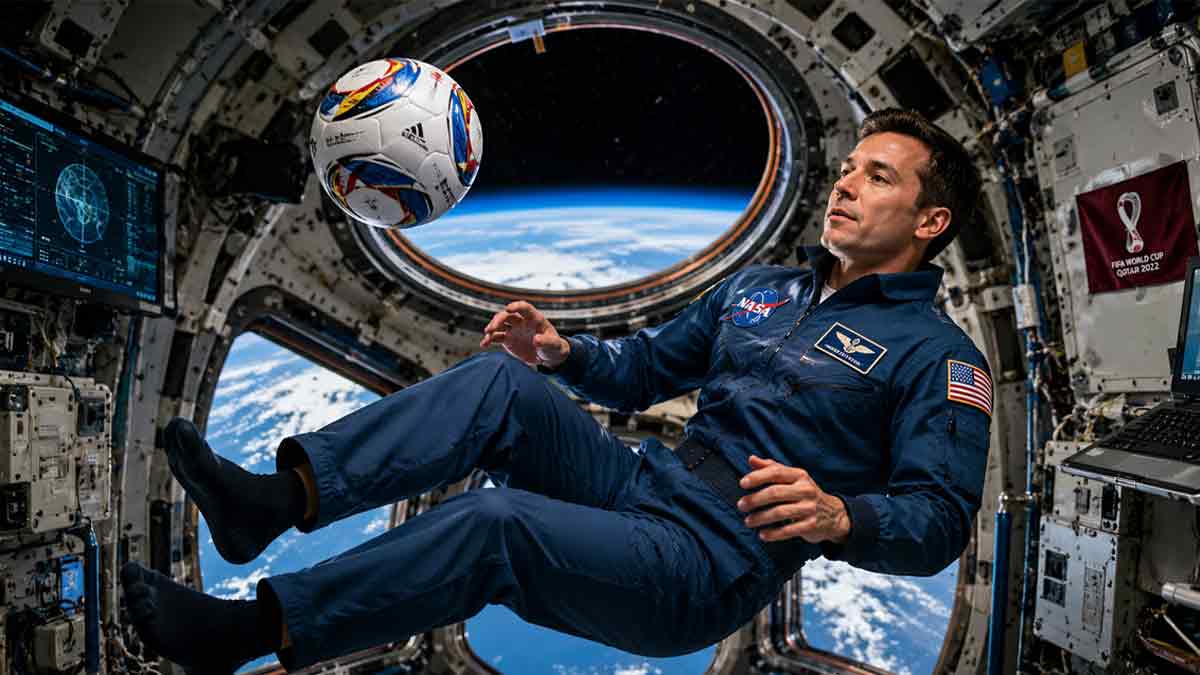
Recently, NASA released a video on social media showing four astronauts, two men and two women, conducting a series of tests with the World Cup ball. Floating inside the ISS, they kicked and passed the ball while observing its movement, speed and trajectory.
Read More: FIFA World Cup: Netherlands Thrash Sweden 5-1 to Storm Top of Group
Unlike on Earth, where gravity dictates the path of a football, the near weightless environment of space produces entirely different results. The footage shows the ball moving much more slowly and taking longer to travel even short distances. With gravity having minimal influence, the ball’s balance, rotation and overall behaviour differ significantly from what players experience on a football pitch.
Scientists hope the experiment will provide valuable insights into how objects move in microgravity. Researchers are particularly interested in understanding changes in speed, spin and direction, and whether these findings could contribute to future developments in sports science and physics.
The project could also have practical implications for long-term human habitation in space. As missions become longer and future space stations or lunar bases become reality, recreational activities and sports may play an important role in maintaining physical and mental well-being.
The spotlight is also firmly on the TriOnda ball itself. Designed by Adidas, the ball celebrates the three host nations of the 2026 FIFA World Cup — the United States, Mexico and Canada. The name combines “Tri,” representing the three countries, and “Onda,” meaning wave, symbolising the unity of the tournament hosts.
Its design features red, green and blue colours inspired by the national identities of the three countries. Beyond aesthetics, the ball incorporates advanced technology, including embedded sensors capable of collecting data related to movement, touch and speed.
As detailed research on the ball’s performance in space continues, scientists believe the findings could contribute not only to future space missions but also to the evolution of football technology on Earth.
By bringing together the worlds of football and space science, the experiment has already captured global attention, proving that even the beautiful game can find a place among the stars.